
Reflective practice has been an important part of both my personal and professional development for many years. My understanding of reflection has been shaped by coaching and supervision literature, systemic thinking, creative approaches to learning and development, conversations in different communities and ongoing dialogue with colleagues from different countries, cultures, and disciplines. Over time, these influences have become part of how I learn, make sense of experiences, develop ideas, and approach my own growth. At the same time, I have become increasingly interested in the uniqueness of reflection.
Over the years, I have explored many reflective models and found each of them valuable. At the same time, I often noticed that my own reflective process rarely felt linear. Ideas circled back, conversations reshaped my thinking, projects developed over months, and relationships influenced both what I noticed and how I made meaning. I became curious whether I could describe that lived process more explicitly.
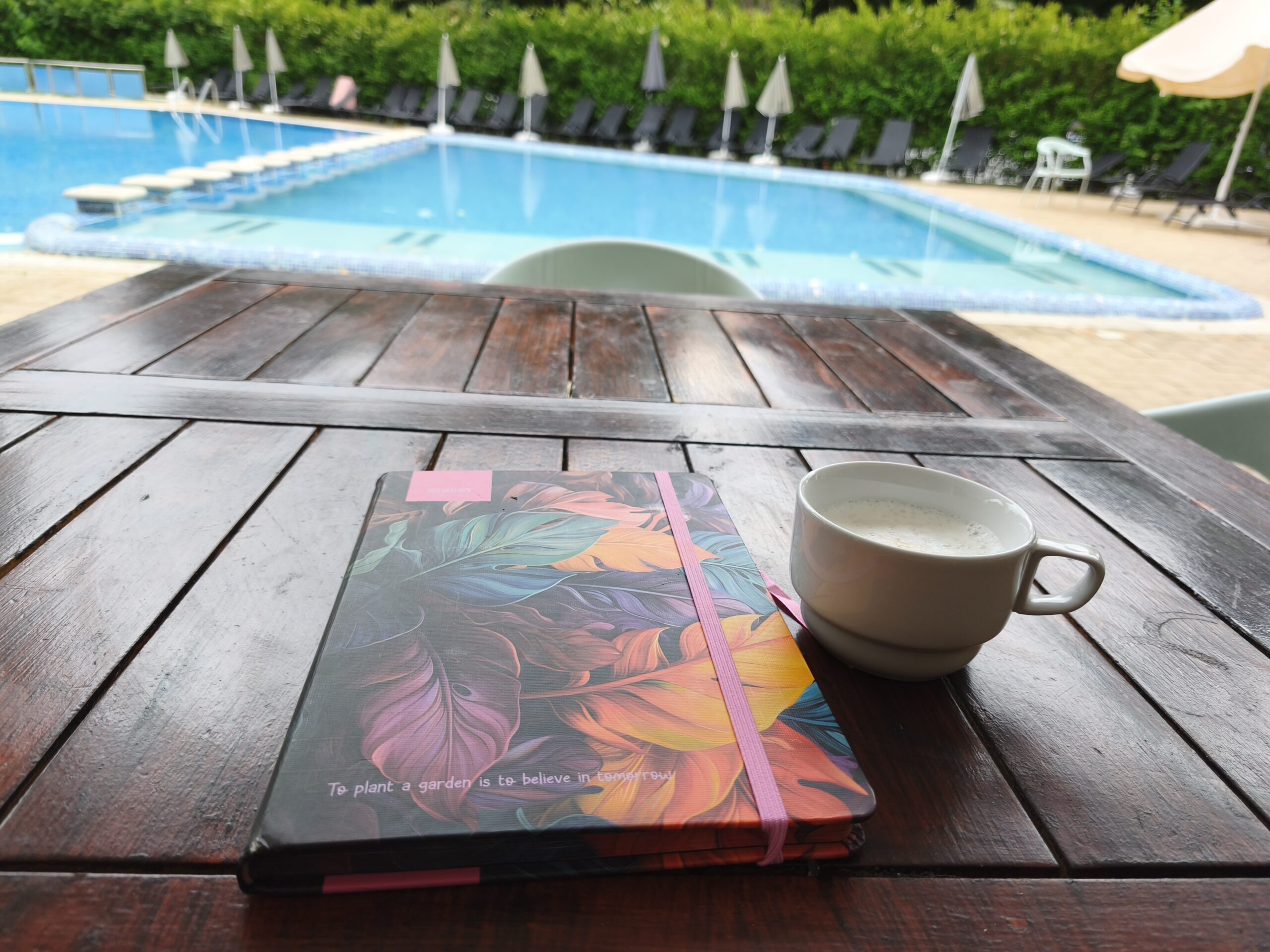
For more than 7 years, morning pages have been one of the most consistent elements of my own reflective practice. Most mornings begin with coffee and a notebook. The pages have become a space where I process experiences, questions, emotions, ideas, and everyday life. Sometimes they contain reflections on projects, conversations, books, or supervision sessions. Other times they are simply a place to empty my mind, follow unfinished thoughts, explore emerging ideas, or make sense of something that is still unclear. The writing could be structured or messy. Occasionally I cannot even read what I wrote a few days later. What matters is the process rather than the result.
One morning, while writing about reflection itself, I noticed that many of the projects and ideas I had developed over the years seemed to move through similar phases. Although the topics were very different, the underlying process was familiar. I returned to it over the following days, adding notes, examples, and observations. As I continued writing, the pattern became increasingly visible. After several days, I sat down with the intention of exploring it more fully and developing it further.
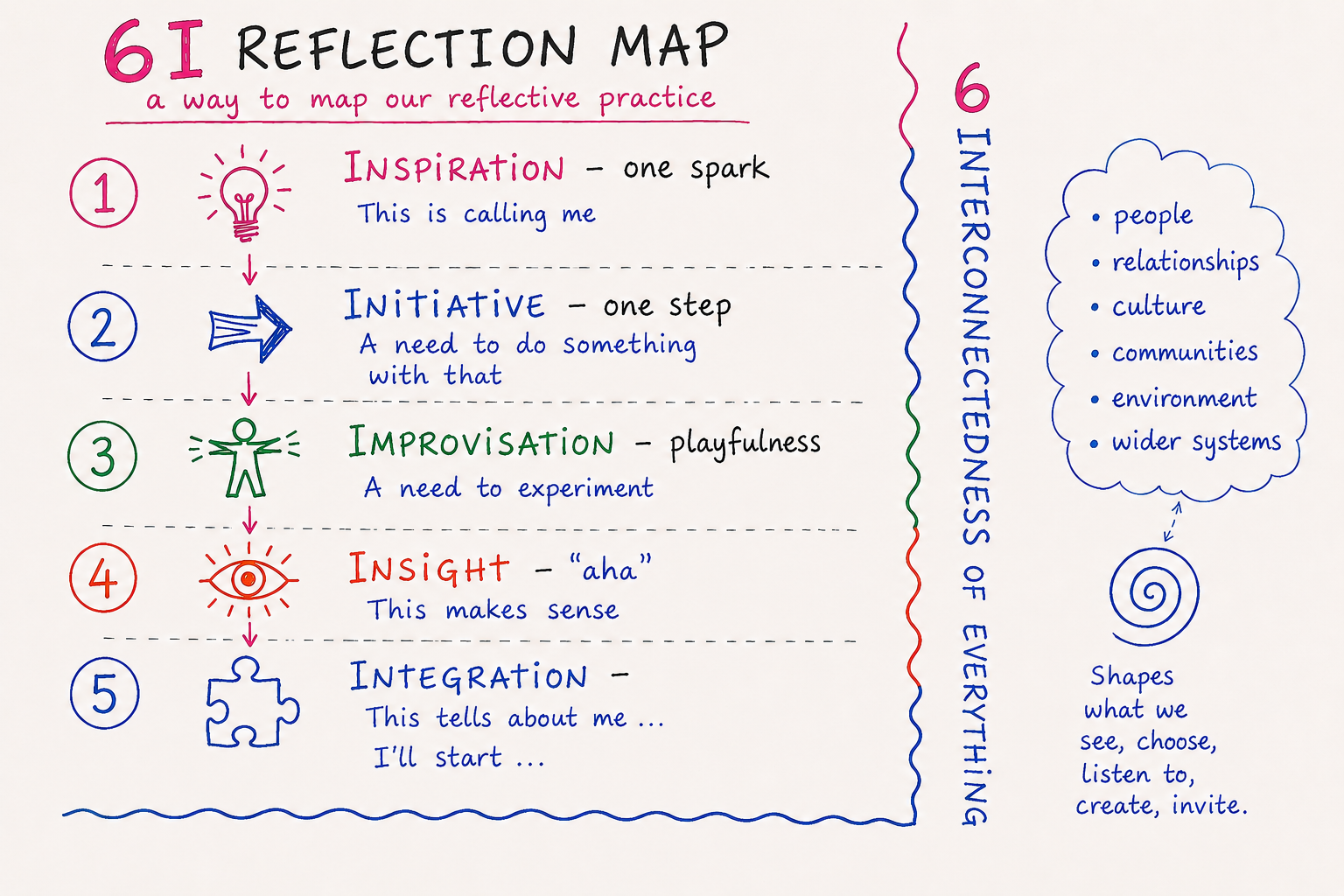
One aspect that gradually became important while developing the map was recognising that reflection is never completely individual. It is constantly influenced by relationships, conversations, communities, cultures and wider systems. The result became what I now call the 6I reflection map.
6I reflection map
The map consists of six interconnected elements: Inspiration, Initiative, Improvisation, Insight, Integration, and Interconnectedness. Together, they represent a way of understanding how ideas, questions, learning, and meaning-making often unfold within my reflective practice.
Let’s look at them together:
Inspiration
A spark that can appear at any time.
Reflection often begins with something that captures attention and creates a desire to explore further. Inspiration may come from curiosity, a question, a tension, uncertainty, a challenge, an experience, a conversation, or a desire to understand something better..
Initiative
A need to do something with the spark.
Initiative represents a conscious decision to engage with what has captured attention. This may involve writing, reading, talking with others, collecting ideas, asking further questions, or creating space to continue exploring the topic.
Improvisation
A need to explore, experiment, and test.
Improvisation is the phase where exploration takes place. Ideas are examined from different angles, tested, expanded, challenged, connected, and revisited. Writing, conversations, reading, supervision, walking, experimentation, and professional dialogue all become ways of engaging with what is emerging. New questions often appear during this phase and influence the direction of further exploration.
Insight
An “aha” moment that begins to make sense.
Insight develops as understanding deepens. Connections become clearer, patterns begin to emerge, and new perspectives become available. Some insights arrive quickly, while others develop gradually through continued engagement with the topic.
Integration
Making sense of insights and considering what they mean in practice.
Integration involves incorporating learning into practice. Insights begin to influence decisions, relationships, professional practice, future projects, and ways of understanding experiences. Reflection becomes meaningful when learning is translated into action, awareness, behaviour, or new ways of thinking.
Interconnectedness
Sharing, asking, exchanging, listening, offering, inviting…
Interconnectedness is present throughout the entire process. Reflection takes place within relationships, communities, cultures, environments, and wider systems. These influences shape what captures our attention, the questions we ask, the perspectives available to us, and the meanings we create. For this reason, interconnectedness is not represented as a separate stage but as an element that runs through the whole map.
Looking back, I can recognise this pattern in many projects and pieces of my work.
An example from my practice
One example is the e-book Exploring Mastery in Coaching.
The inspiration came from a curiosity about mastery and a desire to better understand how coaches holding different master-level credentials experienced and described it. Although I obtained two master level coach accreditations I still have that curiosity in myself. Then the initiative followed as a decision to pursue that curiosity and turn it into a project.
Improvisation started. Interviews were conducted, questions evolved, themes emerged, assumptions were challenged, ideas were explored, and new directions appeared as the project developed.
Insights emerged throughout the process as connections became visible across different interviews and perspectives. Themes related to reflection, presence, learning, contribution, community, and professional identity appeared repeatedly across countries, professional backgrounds, and accreditation bodies.
Integration happened as these insights influenced my own understanding of mastery, shaped future conversations, informed my work, and eventually became part of the publication itself. And inspired the next one. And the next one. 🙂
Interconnectedness was present throughout the project through relationships, dialogue, diverse perspectives, and the collective meaning-making that emerged from bringing many voices together.
6I’s as 6 selves
As I spent more time with this 6I map, I noticed another layer. The letter I represents each of the six elements: Inspiration, Initiative, Improvisation, Insight, Integration, and Interconnectedness and at the same time, it represents the self moving through them.
The self that:
1) become curious.
2) chooses to stay with a question and make some “move”
3) self that explores though specific experiments
4) self that develops understanding.
5) self that integrates learning into practice.
And 6) self that exists in relationship with people, communities, cultures, environments, and wider systems.
In this sense, the 6I reflection map became more than a way of describing reflection. It became a way of understanding how meaning-making unfolds within my own reflective practice.
Further reflections
A colleague invited me to think also about those moments when reflection pauses, circles back or simply refuses to move in this described way. Since then, I have found myself wondering what these moments ask of us as reflective practitioners.
An invitation for you 🙂
I am curious to discover whether others recognise similar patterns in their own reflective processes, and what additional elements might become visible when more reflective practitioners begin mapping their own reflective practice.
- What usually sparks your reflection?
- Where do you notice yourself spending most of your time?
- Which part of the map feels most familiar?
- What else might belong on your own map?
If you find this useful, inspiring or you have thoughts to share, questions to reflect on together – let me know. 🙂